1880-1898
A New Generation
When John Torr died at Carlett in 1880, an important chapter in Eastham’s story came to an end.
But the family’s association with the village — and with its sporting life — continued.
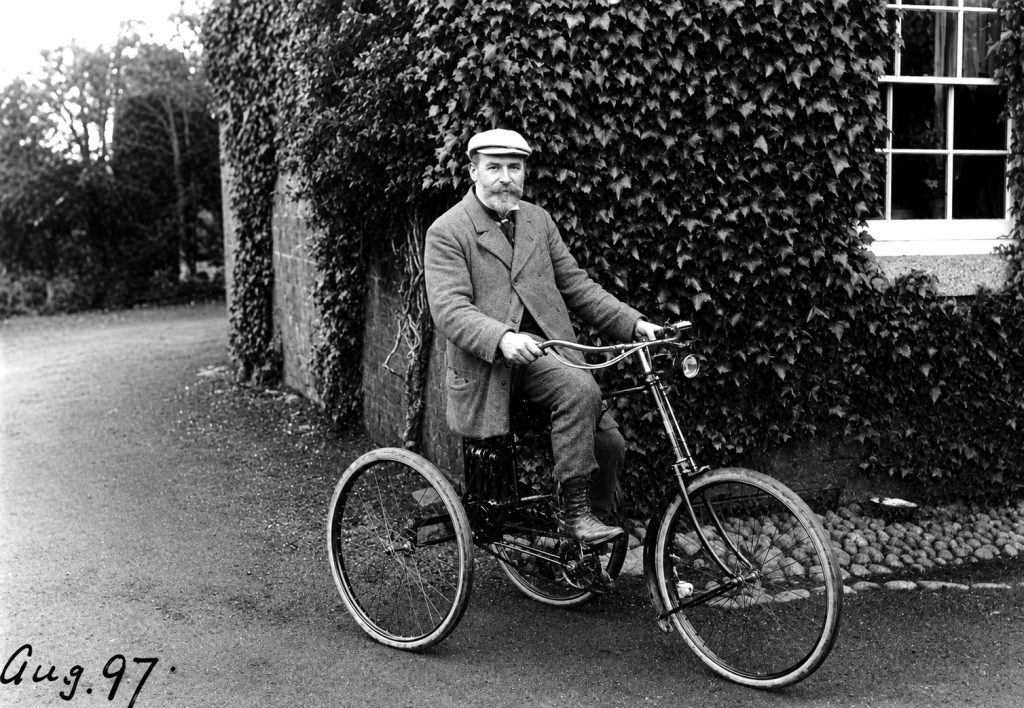
In 1881 his son, the Rev. William Edmund Torr, later Canon Torr, became Vicar of Eastham. He had inherited something of his father’s enthusiasm for sport and recreation, and over the next four decades was to become a central figure in the sporting life of the village.
Carlett Park Takes Root
The following year brought a change to the landscape which can still be seen today.
Eastham wheelwright James Worthington kept a diary recording village events. In November 1881 he wrote:
“Carlett Park – Mr Torr put new trees along the new drive from Eastham New Lodge to the Hall, planted the last week in November 1881. Mr Hook gardener.”
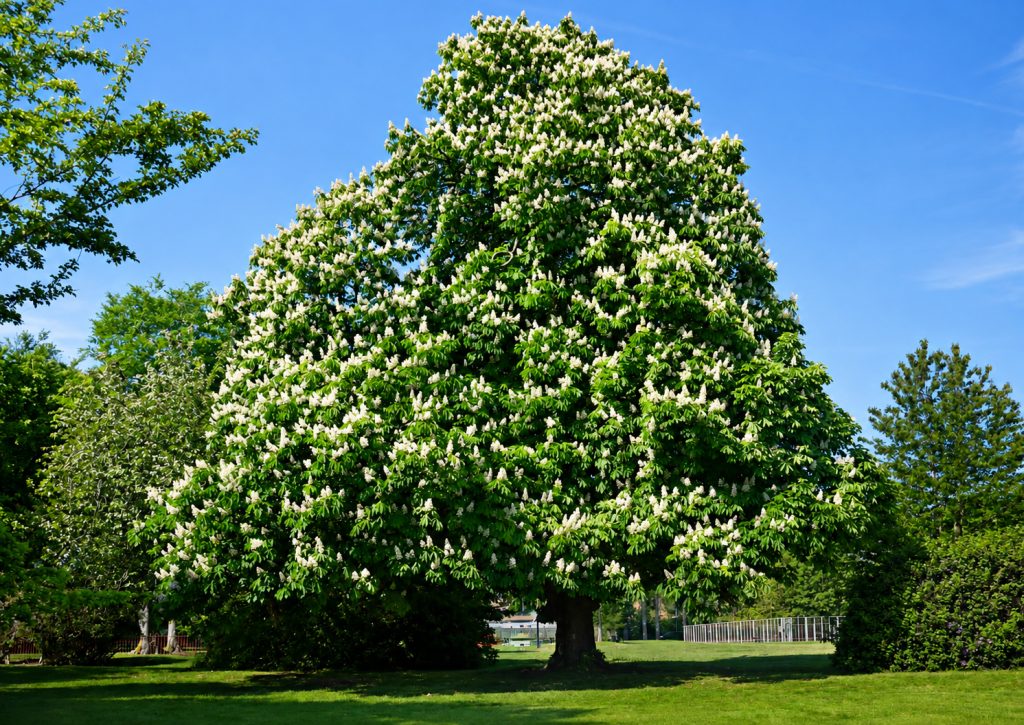
More than 140 years later, some of those magnificent horse chestnuts still survive.
So too does the line of the “new drive”. A slightly raised strip of ground can still be traced between the upper section of today’s Torr Park and the lower cricket ground. It later became known as Townfield Lane.
The landscape of Carlett Park may have changed, but traces of the Torr estate remain beneath our feet.
A Village Cricket Club
Cricket had been played at Carlett Park since at least the celebrated match of 1856.
By the 1880s, however, something had changed. This was no longer simply a place where occasional matches were arranged. Eastham now had an established village cricket club.
The clearest evidence comes from the Illuminated Address later presented to Canon Torr. Looking back on the sporting life of the village, it records:
“There was a strong Cricket Club, with a good ground on Carlett Park from 1881 to 1892.”
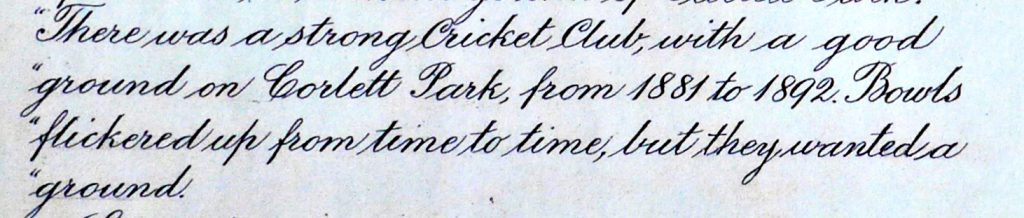
Those few words tell us a great deal.
Carlett Park had become the recognised home of a flourishing Eastham cricket club.
Bachelors v Benedicts
James Worthington’s diary gives us a rather more entertaining glimpse of the cricket being played there.
On Saturday 17 May 1884, the United Bachelors played the Consolidated Benedicts at Carlett Park.
Worthington recorded the result with some amusement:
“The Benedicts, victorious in love and war alike, had all the best of the game and thanks chiefly to the excellent cricket of Mr Frank Tobin won easily.”
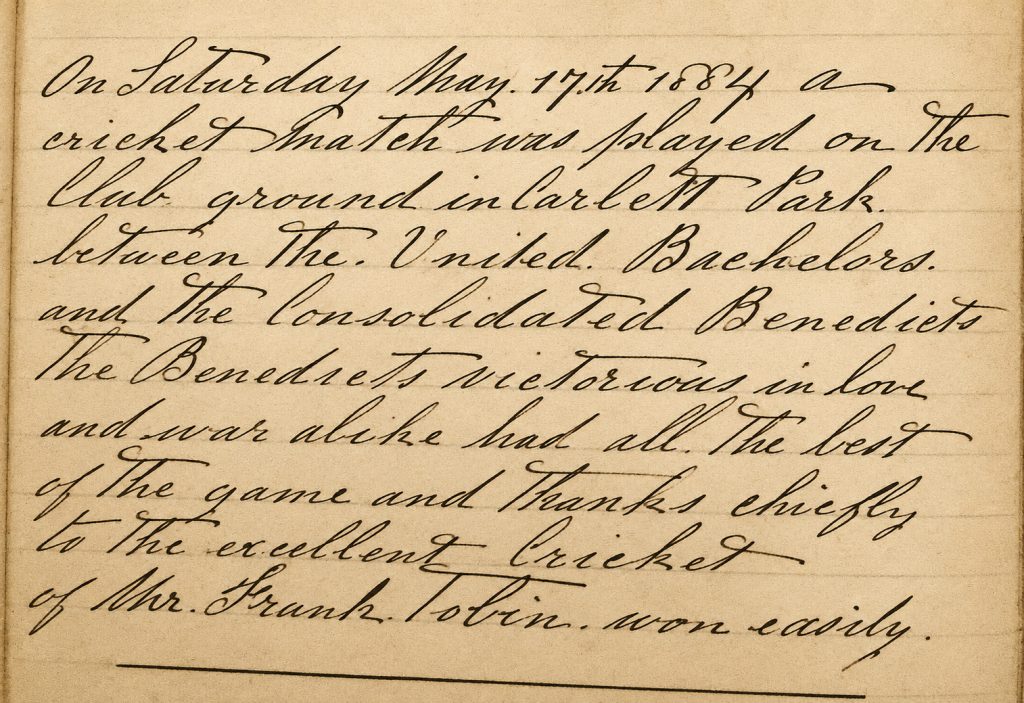
His description of Carlett Park as the “club ground” is significant. It provides contemporary confirmation that Carlett Park was by then the established home of Eastham cricket.
It also gives us something that scorecards alone cannot provide — a glimpse of the humour and companionship surrounding village cricket nearly 150 years ago.
The Men Behind the Club
By 1889 we begin to discover something about the people responsible for running Eastham cricket.
Another entry in Worthington’s diary records a meeting in January that year at which the club’s officers were elected:
Captain — Mr George Clayton
Vice-Captain — Mr Breething
Secretary & Treasurer — Mr H. C. Chambres
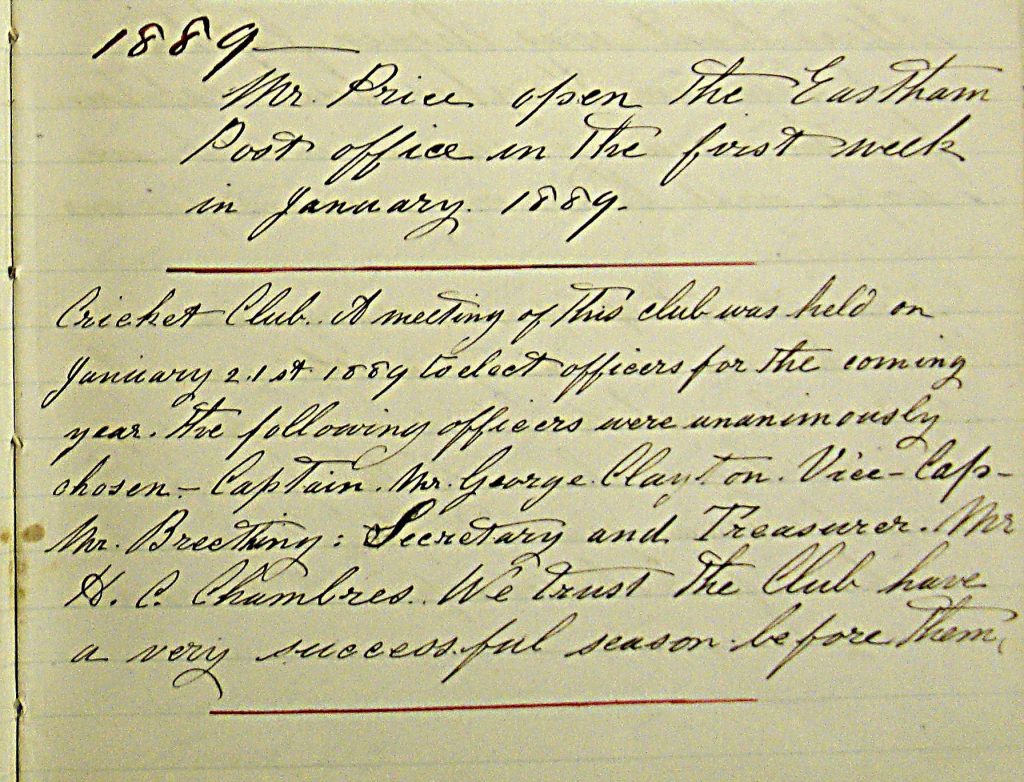
They are just three names in a surviving diary, but gradually the people behind Eastham’s early cricket are beginning to emerge from the records.
As further newspapers, photographs, diaries and documents are uncovered, we hope to discover much more about them.
Explore the people and original records in the Research Centre →
Beyond Carlett Park
By the end of the nineteenth century, sport had become an established part of village life.
Cricket had flourished at Carlett Park. Other clubs and activities had developed too. But Canon Torr and others were beginning to think beyond individual sports and individual grounds.
They envisaged something much more ambitious:
a recreation ground for the whole community.
It would bring together different sports, different generations and different parts of village society in one place.
For a time, it seemed that their ambition had been realised.
But there was a flaw in the arrangements — one that would have consequences nobody could have foreseen.
Explore the Story
Follow the story from the beginning — or jump straight to another period.